
BLUE-RPM
Boosting Low-emission Urban Engine efficiency through Rotations Per Minute Management
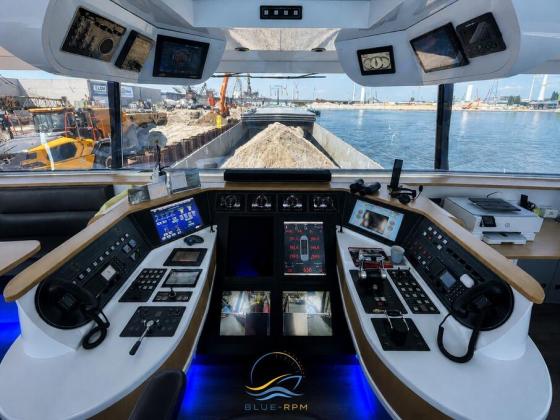

BLUE‑RPM helps inland waterways boatmasters sail more energy‑efficiently by better aligning engine speed and sailing behaviour with the vessel and prevailing sailing conditions. Antwerp Maritime Academy (AMA) investigates, through simulator trials and onboard observations, how the human factor influences energy consumption and how adjusted sailing behaviour can contribute to reduced fuel use and emissions.
Context and challenge
Inland navigation is an energy‑efficient mode of transport, but it faces a significant sustainability challenge. Many inland vessels have more engine power than is needed under normal circumstances. A non‑optimal combination of engine speed, sailing speed and sailing style therefore leads to unnecessary energy consumption and higher emissions
Project objective
BLUE‑RPM develops a data‑driven approach to eco‑sailing based on onboard measurements, engine and sailing data, simulator trials, artificial intelligence and an interactive Decision Support System.
The system is designed to support skippers in real time in aligning engine speed and sailing style with factors such as vessel characteristics, loading, fairway, current and water depth. This can reduce energy consumption without major investments in new propulsion technology. The approach also remains relevant for vessels using alternative fuels, as every energy saving contributes to lower costs and a smaller environmental footprint.
Expected results
BLUE‑RPM aims to demonstrate where unnecessary energy consumption occurs during sailing and which choices made by the skipper make a measurable difference.
The main expected results are:
- an integrated dataset containing engine, fairway, emission and contextual data;
- standardised simulator trials on sailing behaviour and energy consumption;
- analysis of efficient and less efficient sailing styles;
- input for a digital twin and AI model;
- a Decision Support System for energy‑efficient sailing;
- training and awareness‑raising material for the inland navigation sector.
Role of Antwerp Maritime Academy
Within BLUE‑RPM, AMA focuses on the human factor in energy consumption. Onboard measurements provide insight into real‑world practice, while the navigation simulator enables controlled experiments.
During these simulator trials, multiple test subjects sail the same route under identical conditions. Engine speed, fuel consumption, distance travelled, sailing time and emission indicators are logged. This allows AMA to analyse differences in sailing behaviour and determine how much savings are possible through adjusted sailing.
AMA also records additional contextual information onboard, such as loading, unloading, bunkering and skipper decisions that cannot be directly derived from sensor data. This information helps interpret measurement data correctly and model human sailing behaviour more accurately within the digital twin and AI model.
The results are used to formulate recommendations for energy‑efficient sailing, validate the Decision Support System and develop training material.
Partnerships
BLUE‑RPM is a collaboration between Flemish and Dutch partners from research, technology and the inland navigation sector:
- Instituut voor Transport langs de Binnenwateren
- Antwerp Maritime Academy
- Karel de Grote Hogeschool
- Multronic
- Novation
- SAB Maritime Services
- Technische Universiteit Eindhoven
Duration: 11/05/2026 – 10/05/2029
Website: interregvlaned.eu/blue-rpm
Onderzoekers

Dr. Olivier Schalm
AMA, Sustainable Transport